
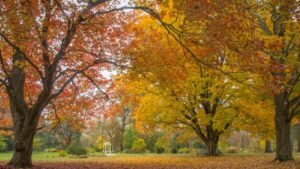
As daylight lessens and temperatures begin to drop, photosynthesis cannot produce energy as fast as needed by deciduous trees. As a result, trees prepare to become dormant, resulting in their leaves turning beautiful shades of red, orange, yellow, deep purples and russet browns.
Throughout the summer, chlorophyll gives leaves their green color because it absorbs light in the blue and red parts of the spectrum while reflecting green. Chlorophyll is essential for photosynthesis which is the process by which all plants transform sunlight into the sugar needed by trees and oxygen needed by animals. Thus, we would not have food to eat nor air to breathe were it not for photosynthesis.
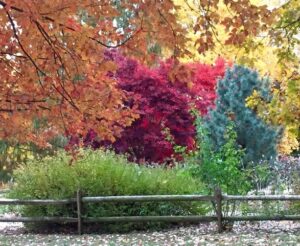
Cool nights and sunny days trigger changes which produce the beloved autumn colors. These weather changes accelerate chlorophyll breakdown while promoting the production of other colorful pigments (anthocyanins and carotenoids).
Carotenoids produce yellow, orange and brown tones while anthocyanins create reds, purples and pinks. Different tree species contain unique combinations and concentrations of these pigments which explains the diversity of fall colors. Hickories turn golden bronze, dogwoods reddish-purple, oaks fade to russets and browns. Sugar maples produce high levels of anthocyanins giving them a scarlet color. Trees growing in nutrient-poor soil or experiencing drought often have more brilliant colors.
Enjoy the autumn show at the Columbus Park of Roses, which has been an accredited arboretum since 2016.