
Now that the leaves have fallen, and perennials, herbs and roses are dormant, you may notice features in the garden that you had overlooked during the growing season. Tree bark is a good example.
It is quickly apparent that not all bark looks the same. 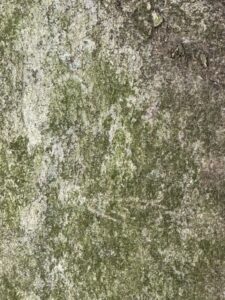 Some bark, such as the European beech on the left, is smooth, while others have coarse, medium or fine texture with shallow or deep furrows. Some bark is white or reddish in color. Some have a peeling or exfoliating appearance; others, such as the honeylocust to the right, have sharp thorns.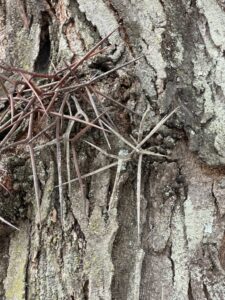
Bark is the outermost layer of tree trunks and branches. This dead tissue protects the tree from threats such as weather extremes, insects, bacterial or viral infections, parasitic plants and animals. Bark has evolved to adapt to the environment in which the tree lives. One example is the thick bark of giant redwoods, which has no flammable material in its bark, enabling them to survive fires.
Some people can identify a tree by its bark. This is no easy feat. There are at least ten categories of bark type (Michael Wojtech). Plus, a tree’s bark generally changes with age. Many trees have smooth bark at a young age and rough bark at a later age. To make identification even more of a challenge, there is much diversity in bark appearance even within the same species.
Two broad categories are smooth bark and rough bark. Within these two types are variations such as those with peeling bark and those with exposed lenticles (breathing holes of the tree). Smooth bark, such as that of beech trees, makes it hard for insects to gain a foothold. However, for a tree to make smooth bark, the tree must grow slowly.
Trees that grow more rapidly, such as oaks, allow for speedy repair of injury. However, this more rapid growth causes the bark to crack, resulting in rough bark that provides a place for insects to live. While these insects provide food for birds, they may pose a threat to the tree.
Learning to recognize trees by their bark could be an interesting winter project as you visit the park. There are helpful field guides that focus on tree bark.